Beaugency had 8,024 residents in the commune in 2023, according to Insee. Its scale makes it an easy town to explore on foot, but its place on the Loire gives it a history larger than its size: the river crossing linked communities on both banks and helped shape the settlement’s streets, fortifications and trade. Today the river is still the town’s main compass, whether you arrive to see its medieval landmarks, cycle the Loire route or simply take a long walk by the water.
A bridge, a keep and a compact old centre
The Tour César rises above the historic core as a reminder that this was a defended crossing, not only a picturesque riverside stop. The tourism office describes the Romanesque keep as roughly 36 metres high and part of the medieval system that commanded the town and bridge. Nearby, the Château de Beaugency carries a different timeline: restored and enlarged for Jean Dunois in the fifteenth century, it received Renaissance alterations under his grandson Jean d’Orléans-Longueville. Since 2021 it has operated as a centre for digital art, bringing contemporary projections and installations into a historic building. The old centre rewards slow walking between the château, the tower, stone lanes and the riverbank rather than a hurried checklist.
Romanesque heritage and a local legend
The former abbey church of Notre-Dame anchors Beaugency’s religious history; the local tourism office traces its origins to the late eleventh century. Saint-Étienne, founded in the same broad period, preserves another Romanesque setting and now hosts exhibitions. Look closely at the difference between an established monument and the stories told about it. The familiar tale says that the devil offered to build the Loire bridge in exchange for the first soul to cross, only to be tricked when residents sent a cat. It is folklore, not a documented construction account, and Beaugency’s residents have adopted the nickname “cats” with humour.
A town still used by residents
Beaugency is not an open-air museum. Insee counted 2,179 local jobs in 2023; employer establishments are concentrated in commerce, transport and services, alongside public services and small businesses that support daily life. Visitors can find places to eat, accommodation, a tourist office, guided walks and family-oriented heritage activities, with availability changing through the year. On the water’s edge, walkers and cyclists share paths and viewpoints; the town lies on both the Loire à Vélo and Scandibérique itineraries. In warmer months, canoe outings and other river activities may be available, but water conditions and operators’ schedules should be checked locally.
Arriving from Orléans or Blois
Beaugency has a regional train station on the Orléans–Blois corridor, making it a practical stop between the larger Loire towns. Regional trains also connect onward through the Centre-Val de Loire network; check live departures for engineering work, service changes and connections. A car or bicycle opens up Meung-sur-Loire, Cléry-Saint-André and the wider countryside, while a rail-based visit can stay entirely within the historic centre and riverfront. A satisfying day can pair the château with the abbey and Tour César, then leave time for the bridge and riverside paths. Opening days, guided tours and train times vary by season, so confirm them before setting out.
 Beaugency in three views: a château, a walk through town and its abbey
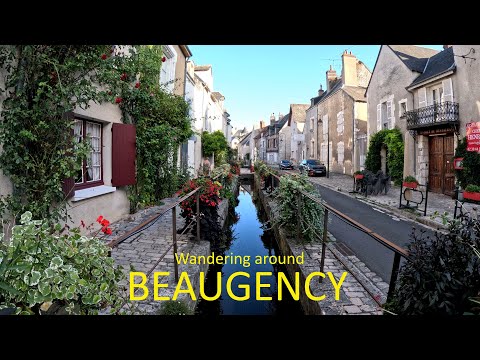 Pete Hayes’s independent travel video follows a visit made in September 2023 through Beaugency’s streets and historic buildings. Its walking pace gives viewers a feel for the compact centre and the relationship between landmarks, rather than presenting a formal lesson in history. Because it is a traveller’s account, use it as a visual preview and check local opening and access details separately.
 My Loire Valley focuses on the former Notre-Dame Abbey church and presents it as a notable Romanesque monument in the Loiret. This narrower subject complements the château and street-walk videos by giving one religious building its own attention. The feature is several years old; restoration work, access arrangements and visit schedules should be confirmed with local visitor services.