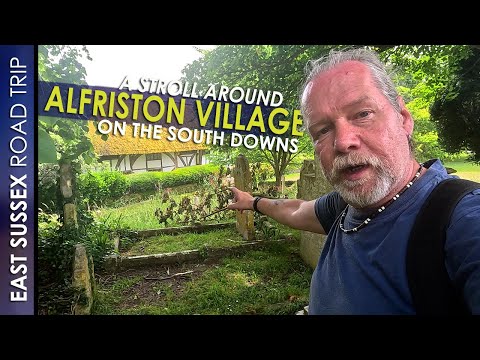
Alfriston stands beside the River Cuckmere inside the South Downs National Park. Its older houses, large parish church and narrow village streets make a compact visit, while paths lead into chalk downland and along the river. The place has a documented medieval history, but the wider valley also contains much earlier archaeology. Those are different kinds of evidence: prehistoric remains in the Downs do not give a founding date for today's village.
Population and the valley setting
The Office for National Statistics estimated 786 residents in Alfriston civil parish in mid-2021. This parish figure should not be confused with a count of people in the main street alone or with the population of the larger national park. Alfriston is a small settlement with visitor services rather than an urban centre. The Cuckmere runs past the village before winding south towards the coast. Eastbourne and Lewes are the nearest larger service and rail towns; Brighton is a more distant city that may matter for work and wider connections.
Documented origins and a market village
The South Downs National Park Authority relates the name to an Anglo-Saxon farmstead of Ælfric and notes that Alfriston appears in the Domesday Book. Its walking guide points out prehistoric long barrows in the surrounding Downs. A medieval settlement can be documented, but it would be misleading to describe the present village as a proven Neolithic or Roman foundation. The conservation area appraisal records a market grant by Henry IV in 1406. By about 1600 the street pattern had largely taken the form recognisable today. The Cuckmere remained navigable towards the village into the twentieth century, helping explain its older connections with the coast.
St Andrew's Church was rebuilt in the fourteenth century on a scale that has earned it the informal name “Cathedral of the Downs”. The Church of England's heritage record cautions that a possible earlier sacred site has left no surviving trace of an earlier church. That distinction matters: the surviving building demonstrates medieval investment, while earlier religious use remains uncertain. The church, its churchyard and the river crossing together give a better picture of the historic centre than any one picturesque façade.
The Clergy House and conservation history
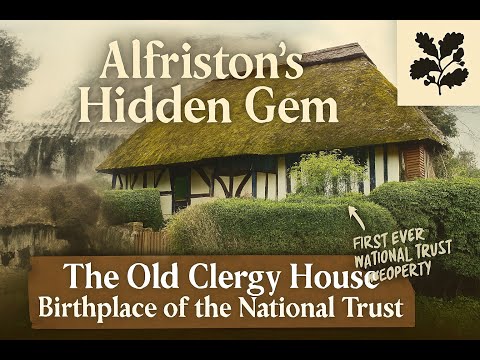
Alfriston Clergy House was built for the priest of St Andrew's under the patronage of Michelham Priory. Tree-ring analysis commissioned by the National Trust dates oak used in the house to felling between 1399 and 1407. Those dates relate to its timber and construction, not the birth of the village. The medieval hall house was altered after the Dissolution, when the priory was closed. Later work changed its rooms and roof, so the interior is the result of several centuries rather than a perfectly untouched medieval home.
In 1896 the newly formed National Trust purchased the house for £10. It was the Trust's first building, and the repairs helped shape its approach to caring for historic places. The property opened to visitors much later. Today the house and Arts and Crafts inspired garden offer an unusually direct way to explore both medieval domestic space and the beginnings of organised conservation. Check the National Trust's current opening days before making it the centrepiece of a trip.
Smuggling, landscape and things to do
The national park's village guide records troops stationed locally during the Napoleonic Wars and later smuggling along the Cuckmere. It describes the Alfriston gang as violent; this was a particular episode in local history, not a reason to romanticise every old inn as a smugglers' hideout. The historic core is best explored on foot, taking in the church, Clergy House and surviving market-village streets.
For a longer outing, the national park publishes an Alfriston and River Cuckmere circular walk through neighbouring countryside and Litlington. The South Downs Way also passes the village. Walking conditions change with rain, river levels and exposed chalk paths, so choose a route and footwear to match the weather. Seven Sisters and the Cuckmere estuary make a separate coastal excursion; they are nearby attractions rather than sites inside Alfriston. A short stay can combine the village's buildings with one of these very different landscapes.
Connections and a practical stay
Alfriston has no railway station. Rail travellers can approach through Eastbourne, Lewes, Polegate or Seaford according to their route, then continue by bus or road. East Sussex County Council lists a route through Lewes, Alfriston, Polegate and Eastbourne, and seasonal changes affect some services. Check the live timetable and the last return bus rather than assuming an easy evening connection. Drivers approach through the A27 corridor and local roads. In the village itself, walking is the natural way to connect the main sights; parking and narrow streets make unnecessary short car trips less attractive.
There is accommodation and food in Alfriston itself. Wingrove House advertises guest rooms and a restaurant on the High Street. Village pubs, cafés and other small lodgings provide further choices, subject to current opening and availability. Eastbourne and Lewes offer a wider range if a room in the village is unavailable. For a prospective resident, Alfriston's modest population, protected landscape and visitor trade mean a different daily routine from Eastbourne or Brighton. Work and specialist services may require travel, and a housing decision should be based on actual listings and transport needs. The sources reviewed here do not establish a reliable current average rent for Alfriston parish, so no precise rent is claimed.
Sources
- ONS: mid-2021 civil parish estimates
- South Downs National Park Authority: conservation appraisal
- South Downs National Park Authority: village history and Cuckmere walk
- Church of England: St Andrew's heritage record
- National Trust: history of the Clergy House
- National Trust: visiting the Clergy House
- East Sussex County Council: local bus routes
- Wingrove House: rooms and restaurant