Stroncone is a hill town south of Terni, looking across the Terni and Narni valleys from a landscape of olive groves, woods and small settlements. The commune is larger than its compact walled centre: its territory includes the villages of Aguzzo, Coppe, Finocchieto and Vasciano as well as the highland area known as I Prati. Istat estimates 4,606 residents for the entire Comune on 1 January 2026. That is a provisional resident-population estimate for the municipality, not a count of people living inside the old walls.
A documented medieval settlement, not a proven Roman foundation
The Comune is careful about the origins. Some writers have identified the site with ancient Trebula Suffena, but the municipal account says there is no certainty about the settlement’s beginnings. An early medieval watch post on a route between the Lombard duchy of Spoleto and Byzantine-held territory is a plausible explanation, not an established excavation result. The proposed derivation of the name from “castrum Hugonis,” associated with a Duke of Spoleto called Ugone, is also an etymological hypothesis. The first document that securely names the settlement dates to 1012; by the eleventh century, records describe a defended castle with walls, homes, a square and places of worship. Pope Innocent III granted Stroncone municipal autonomy in 1215, after which its political history remained closely tied to the Papal States and the neighbouring cities of Narni and Terni.
That layered past is easiest to read on foot. The Main Gate opens toward Piazza della Libertà and the Fountain of the Three Cups, a civic landmark attributed to 1559. Inside, lanes climb through Piazza San Giovanni, with its medieval well and oratory, toward the church of San Nicolò and the former civic palace. The old walls and steep, winding streets are not a theatrical reconstruction; they shape how residents and visitors move through the centre today. Set aside time for the climbs and look back toward the valley as the roofs fall away below.
Choir books, natural history and Franciscan memory
Two small museums give Stroncone a cultural offer beyond its architecture. The Choir Museum occupies the old church of Madonna del Gonfalone and preserves illuminated parchment choir books from the fourteenth century, once used by the collegiate churches of San Michele Arcangelo and San Nicolò. The municipal listing says entry is free by appointment and the site is accessible to visitors with disabilities; check current arrangements before going. The Natural History Museum grew from work begun in 1976 with the local speleological group. Its collections cover fossils, geology, zoology and ethnology, with educational activities and guided visits offered by appointment.
Just beyond the walls, the Convent of San Francesco stands among olive trees and woodland. Local religious tradition attributes its foundation to Saint Francis in 1213; the date belongs to that tradition, while the complex was repeatedly altered and its present form includes later building work. A chapel holds the remains venerated as those of Blessed Antonio Vici, a co-patron of Stroncone. The church also preserves a fresco by Tiberio d’Assisi dated 1509. It is a place where religious devotion, local memory and art meet, and visitors should confirm access with the friars before travelling.
From the lanes to I Prati
Stroncone’s territory changes character quickly above the town. The local tourism portal describes I Prati, at about 1,000 metres on Monte Macchialunga, as a highland landscape of clearings, chestnut trees, woods and trails. A medium-difficulty Franciscan route begins at Piazza della Libertà, passes the former oratory of San Rocco, now the church of Madonna del Colle, and reaches the uplands in roughly one to one-and-a-half hours. The route is associated with Franciscan travel and later popular devotion; claims about individual saints walking every section belong to local tradition. In summer, the portal lists a bar, restaurants, a small shop, play area and campsite near the chapel, but seasonal services can change. Check trail conditions, weather and what is open before setting out.
Olive oil and local food are part of the modern visitor offer as well as the surrounding agricultural landscape. The commune’s event calendar includes Pane e Olio and village food festivals, while hiking and the Franciscan routes bring visitors beyond the main square. This is a small community where hospitality, local associations, farming and heritage events overlap; the calendar should be checked for current dates rather than treated as a year-round programme.
How to arrive and what to combine
Stroncone has no active railway station for visitors. From Terni railway station, continue to the bus terminal and take Busitalia’s E622 toward Stroncone; the published 2026–27 timetable has departures with different weekday, school-day and holiday conditions. By car, the Franciscan community’s directions lead from the A1 Orte exit through Terni. Terni is the practical transport base; nearby Narni adds another historic town, while the trail toward I Prati and the Franciscan sites around Greccio offers a longer outdoor itinerary. Confirm the bus for your travel date, museum appointments, convent access and seasonal services before making the trip.
 Stroncone in video: the walled centre, a village portrait and the upland ride
 Fly Up’s short film is titled simply “Stroncone” and is embedded on UmbriaExperience’s destination page. It adds another independent visual impression of the settlement, but the sparse title and description provide little basis for identifying individual monuments or reconstructing a route. It works best as a brief preview rather than a historical or practical guide. Pair its images with the local tourism portal, which identifies the walled village, museums and nearby places such as the Convent of San Francesco and I Prati; verify current opening arrangements before visiting.
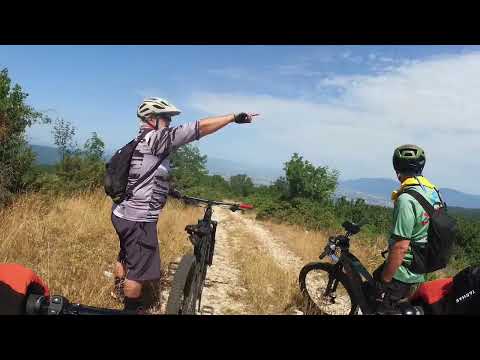 TodiNatura’s film follows a ride from Miranda toward the Prati di Stroncone, so its subject is the wider landscape rather than a walking tour of the old centre. The associated Wikiloc route describes a 34.58-kilometre mountain-bike circuit with 914 metres of ascent and rates it difficult. Those figures belong to that user-submitted route, not to a general visitor trail, and they do not confirm current surface or safety conditions. The film is useful for understanding the scale and changing terrain above Terni; check the route record, weather and local trail advice before attempting it.