Savukoski is less a compact town than a small community at the southern edge of an immense Lapland landscape. Statistics Finland counted 974 residents in the municipality on 31 December 2025; that figure covers the entire municipal territory, not just the church village. The municipality spans 6,470 square kilometres, and most settlement lies in its south. From the centre, roads and rivers lead toward long distances of forest, mire and fell country. The contrast between a few village services and a wide, sparsely settled hinterland is part of the place’s character.
A young municipality with an older working landscape
Savukoski was established as a municipality by a decision of the Imperial Senate in 1916. Its livelihoods have long depended on the surrounding land and waterways. Forestry remains significant, while reindeer husbandry is both an important livelihood and a cultural practice. The municipality says the Kemin-Sompio reindeer herding cooperative is Finland’s largest and that reindeer work provides supplementary income to just under 200 owners. Natural-product processing and tourism are among the fields being developed. These are not just themes for visitors: they help explain why seasonal work, access to forest and the annual cycle of herding still shape local life.
Local tourism information also describes a regional Forest Sámi culture, using the Finnish term metsälappalainen, and points to inherited ways of life and handicraft traditions. That description belongs to a specific regional history; it should not be flattened into a generic Lapland image. The nearby landscape is also home to extensive protected areas. The municipality says about a third of its territory is under nature protection, including Urho Kekkonen National Park, Värriö Strict Nature Reserve, Kemihaara Wilderness Area and Maltion Strict Nature Reserve.
Landmarks between the centre and the wilderness
For a first visit, the Savukoski church village is the practical base. Its small service centre has a grocery, pharmacy, bank, fuel station and hotel-restaurant, according to local visitor information; Tanhua, one of the outlying villages, also has a grocery. Cabins and other accommodation are distributed across the area, so it is sensible to plan meals, fuel and overnight stops before leaving the centre. The town’s scale is part of the experience, but it also means that a shop or service should not be assumed to be open late or every day.
Puistola, the local-history museum in the village, offers a close view of postwar rebuilding rather than a distant, heroic past. Väinö and Hilda Halonen built the house in 1947 after returning from evacuation. Its rooms, barn and collections preserve domestic objects and local history, and the house opened as a museum in 1998. Puistola is open by reservation only, so contact the municipal cultural service before setting out. Further away, the Tarkkala wilderness farm recalls the logging and reindeer routes that once crossed this region. The farmstead survived the Lapland War and was used year-round into the 1980s. A series of separately announced pilot events tested new uses there in 2026; regular summer opening for 2027 had not yet been announced when this guide was researched.
The northern endpoint of the Salpalinja, Finland’s wartime defence line, lies near the centre. Its older walking route is undergoing repair and conversion into a multi-use path, with municipal work scheduled for completion during October 2026. Check the live municipal notice before visiting: the earlier route description may not match the site while works continue.
Rivers, fells and demanding trail country
Outdoors is the municipality’s strongest invitation, but the distances and conditions deserve respect. Nuortti River runs through a rugged landscape in Urho Kekkonen National Park; Metsähallitus describes its marked route as wilderness hiking, where water levels and river crossings matter. The Korvatunturi route is longer still: about 40.7 kilometres over two to three days from Kemihaara, classified as demanding. Some facilities in the park’s southern wilderness are no longer maintained. Bring current maps, check trail and service notices, and plan for weak mobile coverage rather than treating these routes as casual walks from the village.
Korvatunturi is known in Finnish tradition as Santa Claus’s home mountain. The mountain stands by the Finnish-Russian border inside the national park, and entering the border zone requires a permit from the Finnish Border Guard. The folkloric connection is part of Savukoski’s public identity, but the real appeal is also geographical: a remote fell, mires and forest routes in one of Finland’s largest wilderness landscapes. Closer to the centre, the local visitor service lists Kivitunturi’s nature trail, village sites and the Salpalinja among more manageable points of interest; check the current condition of each path.
Getting there and planning a visit
The nearest railway station is in Kemijärvi, about 95 kilometres away by the distances listed by local visitor information. Buses continue toward Pelkosenniemi, with a demand-responsive taxi connection to Savukoski. The municipal 2026 schedule lists weekday services and requires advance booking by 18:00 on the previous evening; particular village routes run only on designated days. Pelkosenniemi is about 43 kilometres from Savukoski, Salla 82, Sodankylä 90 and Rovaniemi 175. These are distances, not guaranteed journey times. Confirm the train, bus and taxi connection for your travel date, and arrange local transport before booking a remote cabin or trailhead.
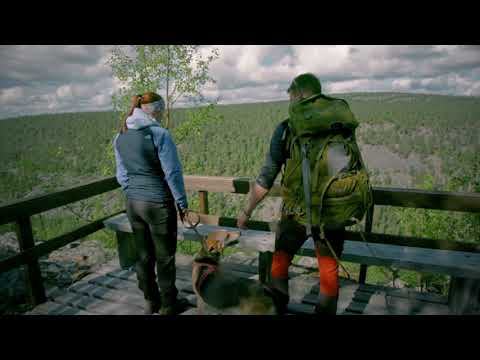 Savukoski on film: summer wilderness, Tarkkala and a Christmas tradition
 This podcast brings a local development story into focus. Municipal culture and marketing secretary Susanna Schwartz-Matero speaks with entrepreneurs Tiina Pulkka and Tuuli Rautava about their businesses and the pilot events planned for Erämaatila Tarkkala in summer 2026. The conversation places a remote historic farm within the present-day work of maintaining and finding uses for local heritage. It records plans at the time of publication, not a continuing event calendar; check with the municipality before travelling to the farm.
 The video records Savukoski’s 2025 Christmas send-off celebration, a public gathering built around the familiar local tradition that Santa sets out from Korvatunturi. Its value is as a record of a community event and the way the story is marked in the village. The tradition is folklore, not evidence that Santa’s mountain home is a historical fact. The film is also date-specific: it does not confirm this year’s event programme.