Preci is not a single postcard scene but a small mountain municipality spread across the Castoriana Valley. The historic village sits on a slope above the valley floor; beyond it, hamlets, churches, springs and wooded ridges make the wider Comune part of the experience. That geography matters: a visit here is best planned as a slow look at a settlement and its territory, not as a quick stop expecting a packed resort centre.
A village shaped by the valley
Preci stands at about 596 metres above sea level. The municipal territory follows much of the Castoriana Valley between Forca di Ancarano and Ponte Chiussita. The Comune describes a landscape of limestone, karst springs, woodland and smaller settlements. Hemp was once grown in small plots known locally as canapine, while medicinal plants were gathered in a region where monastic communities also cultivated knowledge of herbs. These are traces of a rural economy built around land, water and movement between hamlets; they should not be mistaken for a claim that one industry still defines local employment today.
Istat’s resident-population estimate gives the entire municipality 678 residents on 1 January 2026. This figure covers the Comune, including its dispersed settlements, rather than the historic village alone. The modest scale and the spread of habitation explain why visitors should check services and transport before setting off: the places that make up Preci are not all clustered around the central square.
What the records say about its past
The first document cited by the municipality that names the settlement dates to 1232. It is evidence that Preci existed by then, not a founding date. The Comune says a castle was built in the second half of the thirteenth century and that the territory passed under Norcia in 1276. After Preci rebelled and sheltered the lords of Camerino, Norcia’s forces destroyed it in 1528. The municipal account says rebuilding was authorised in 1533 after a formal reconciliation with Norcia and with the assent of Pope Paul III.
The name is sometimes connected to the Latin word preces, or prayers, because the early settlement stood near a Benedictine oratory. The Comune presents this as a probable explanation, not a proven etymology. The nearby Abbey of Sant’Eutizio has a separate and much older religious history: regional heritage accounts place its beginnings in the fifth century and connect the tradition to the late-sixth-century writings of Gregory the Great. The surviving complex was developed over later centuries. The distinction matters: a rich monastic tradition does not establish that the village itself was founded in Roman, Greek or other ancient times.
The surgical tradition, told with care
Preci is strongly associated with the Scuola Chirurgica Preciana. Italy’s Ministry of Culture describes a surgical school documented from the twelfth century, whose practitioners became known for eye operations, hernia surgery and urinary-stone removal. The municipality and regional tourism accounts connect the community’s medical knowledge with Sant’Eutizio’s learning and the transfer of skills from religious to lay practitioners. They also relate that transition to the Fourth Lateran Council of 1215. The precise beginnings are best treated as a historical interpretation rather than a single, fully settled origin story.
During the sixteenth century, doctors from Preci gained a reputation beyond Umbria. The municipal history names Durante Scacchi, born in Preci in 1540, and his brother Cesare, whose career is linked by the town’s account to the English court. Instruments attributed to the school are mentioned in the local heritage record, but attribution is qualified. The former church of Santa Caterina housed the Surgical School Museum; the Ministry’s current listing shows it as closed, so do not assume it can be visited. The medical history is compelling without turning local legends or devotional stories into evidence of medical practice.
Streets, churches and the wider landscape
In the historic centre, the Palazzo Comunale faces the main square. The castle, rebuilt through repeated destruction, and Santa Caterina’s portal give the compact settlement a layered architectural character. Santa Maria preserves fragmentary fourteenth- and fifteenth-century frescoes. In nearby Roccanolfi, Poggio di Croce and Montebufo, parish churches preserve paintings from the sixteenth and seventeenth centuries, according to the regional visitor guide.
Below the village, Borgo Preci follows the Campiano stream. The municipal territory page points to the seventeenth-century church of Madonna della Peschiera and to old mill remains beside a path that once linked the lower settlement with the castle. The Abbey of Sant’Eutizio, at Piedivalle, is the valley’s landmark: its cliffside position and long monastic and medical history make it central to understanding the area. As of this research, the Comune says the abbey is temporarily closed and can be viewed only from outside; the regional tourism page likewise says its interior is not visitable while restoration continues. Contact the parish or municipality before travelling specifically to see inside.
Walking, food and useful services
The Sibillini Mountains National Park presents the Valle Castoriana as a cycling and walking area, but its own route page flags the B12 itinerary as not fully usable or subject to significant deviations. Check the park’s latest trail notice before attempting a walk, and do not rely on older route descriptions after earthquakes and restoration work. For a shorter visit, staying around the village, the valley viewpoints and accessible hamlets offers a more cautious way to read the landscape.
Preci’s visitor offer is tied to the wider Valnerina: local and regional tourism listings include accommodation and food businesses, while the surrounding area connects naturally with Norcia, Visso and the Monti Sibillini. The municipal website lists a community pharmacy in Preci; opening times and holiday cover should be checked directly. There is no basis for describing the village as a major service centre, so arrange meals, lodging and onward transport ahead of time, especially outside the busier seasons.
Getting there
Busitalia’s E403 links Norcia, Preci and Borgo Cerreto, with continuation from Borgo Cerreto toward Spoleto on line E401 when the timetables connect. The current winter schedule runs from 25 September 2026 to 8 June 2027 and has a small number of departures with weekday and school-day validity notes; check the operator’s timetable and connection rules before travelling. By road, regional tourism information describes access to Sant’Eutizio from the Norcia area via SP476. At the time of writing, 11 October 2026, the Comune has ordered a full closure of SP475 del Muraglione at km 6+480 from 28 September through 27 October, or until work is complete. That notice concerns a specific road segment and does not by itself establish that every approach to Preci is closed; verify the route with the Comune and road authorities before departure.
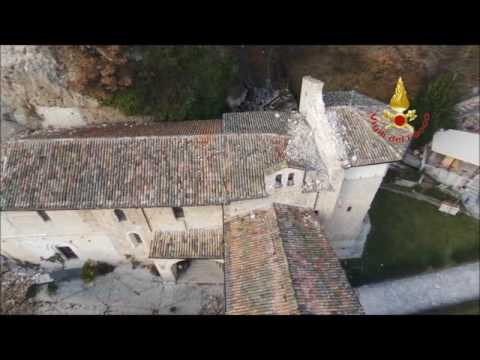 Preci on film: abbey heritage, hermitage and a mountain road
 This independent 2013 film turns to the Eremo di San Fiorenzo, a remote religious site in the Preci area. It offers a visual introduction to the hermitage landscape, where rock, woodland and distance help explain why small religious communities chose secluded places in the Castoriana Valley. The legends associated with early hermits belong to local devotional memory; the footage cannot verify their events or dates. More practically, the upload is old and is not a route guide. The national park flags deviations or limited usability on one local itinerary, so check trail and access conditions before setting out rather than following the film as current directions.
 TuttOggi’s October 2017 report documents the reopening of the provincial road between Preci and Visso after earthquake-related landslide work. It is useful as a dated account of how a damaged mountain connection affected two neighboring communities and how authorities approached its restoration. It does not establish present road conditions, and the video’s historic timetable or reopening arrangements must not be reused as current travel advice. Compare this archive with the municipality’s latest notices and road information before planning a drive. Together, the three films show Preci through heritage, landscape and the practical challenge of maintaining connections in a mountain valley.