A market town shaped by water
Pamiers is the largest town in Ariège, but it is often passed over on the way to Foix, the high valleys or the Pyrenees. Its centre rewards a slower visit. Here, the Ariège is not just a name on a map: watercourses frame the historic core, brick bell towers punctuate the skyline, and old religious buildings stand alongside workshops, shops, schools and a working railway station. The result is a town with a distinctive mix of civic life and heritage rather than a preserved stage set.
INSEE counted 16,473 municipal residents across the commune in 2023, at a density of 359.3 people per square kilometre. The number includes the whole municipality, not only the central island of streets and canals. A useful way to read Pamiers is to follow the water through the old centre, then cross its layers of religious and commercial history before looking at the industrial activity that still helps sustain the town.
From Frédélas to a medieval trading centre
The municipality’s urban heritage diagnosis is careful about the earliest past. It describes archaeological evidence of occupation by the Roman period and says habitation may go back further, but that is not proof that the present town was founded by Rome. The first documented urban nucleus in the local account is medieval Frédélas, growing in the tenth century around the Castella and the Mercadal market. Pamiers expanded more decisively from the thirteenth century, when its market, religious institutions and water-powered work made it a centre for the surrounding plain.
In 1229 the town’s bourgeois inhabitants received a charter of franchise, a marker of commercial and civic organisation. Authority was shared and contested among the abbey of Saint-Antonin, the counts of Foix and the town’s merchants; the bishopric became another major power from 1295. These changing relationships help explain why a compact town accumulated so many religious and civic landmarks. Pamiers was not shaped by one founder or a single clean origin story, but by institutions and residents negotiating control of a strategic river crossing and market.
The canals are the feature that makes this history legible on foot. The municipality dates them to the eleventh century. Its planning diagnosis proposes that they follow former arms of the Ariège and that a major flood in the twelfth century changed the river’s course. That is a local historical reconstruction rather than a certainty to turn into legend. The channels ring the old centre, once helping to defend it and later supplying water for textile and leather work. Today they give the streets a rare urban rhythm: bridges, brick façades and shaded edges appear as part of everyday circulation.
Three bell towers and a religious city
Pamiers is known locally as the city of three bell towers. The cathedral of Saint-Antonin, the church of Notre-Dame-du-Camp and the Cordeliers tower give that phrase a visible shape, but the protected heritage is broader. The municipality lists nine historic monuments, including the canals, the former Carmelite convent, the old abbey of Saint-Antonin at Cailloup, and both major churches. Look beyond the largest façades: the historic streets also contain old houses, smaller lanes and the remains of institutions whose courtyards and gardens are still being adapted for public use.
Notre-Dame-du-Camp and the Romanesque church of Cailloup date to the twelfth century in the city’s account. Cailloup lies beyond the dense centre, in a quieter setting by the Ariège, and offers a different sense of the town’s religious past. The cathedral’s brickwork and organ, the crenellated front of Notre-Dame-du-Camp, and the octagonal Cordeliers tower make an effective walking sequence through the core. The local visitor office describes two marked circuits: one follows the Camino de Santiago route across town and visits the principal monuments; the other explains how the canals supported local industry.
The Carmel adds another layer rather than simply repeating the church story. Built from 1648 as a Carmelite convent, the large walled complex was acquired by the city in 2012. It now hosts contemporary art exhibitions and includes the former hospital pharmacy, with its historic medicinal preparations. The current municipal page lists free public access on weekday afternoons and Saturday morning and afternoon, though schedules can change with exhibitions. Even when the galleries are closed, the Carmel’s scale and brick cloister show how a religious enclosure has been given a new civic role.
Industry, markets and a regional centre
Pamiers has been an industrial town since the nineteenth century. Municipal information describes metalworking and precision manufacturing connected to aerospace and energy, including forged components and aircraft parts. The town also supports a wide commercial area and public services. INSEE counted 11,411 jobs at workplaces in the commune in 2023. At the end of 2024 it recorded 757 employer establishments: 67.4 per cent were in commerce, transport and varied services, 7.5 per cent in industry, and 12.8 per cent in public administration, education, health and social work. Those are establishments, not a breakdown of jobs, but they show how much the local economy extends beyond heritage tourism.
The weekly markets make the centre’s commercial role visible at street level. The municipal calendar currently lists markets on Tuesdays, Thursdays, Saturdays and Sundays; the Sunday market includes a flea market. Locations can move when works or events affect the squares, so check current notices before planning around a specific stall or market day. The old centre also concentrates shops, cafés and restaurants, while public facilities include the Val d’Ariège hospital, cultural venues, a cinema, a conservatory and the Jeu du Mail performance hall.
Music is part of Pamiers’ identity through its best-known native son, composer Gabriel Fauré. The city identifies itself as his birthplace and maintains a conservatory for music, dance and theatre. The municipal cultural calendar includes concerts, exhibitions, festivals and local events across the year. Rather than promising a particular event on a fixed date, check the current programme; some performances require advance booking.
Green pauses and nearby journeys
For a pause between monuments, the municipality identifies the Parc municipal du Chalonge and the Île aux Enfants among its public green spaces. The Ariège and its canals make an easy thread for a walk, while the marked city circuits provide a more structured route. The surrounding region moves quickly from the alluvial plain to the first foothills. Foix lies south on the same rail corridor, while the line continues from Pamiers toward Ax-les-Thermes and Latour-de-Carol, opening the door to the mountain towns and valleys beyond. Pamiers can therefore work as a visit in its own right or as a practical base between Toulouse and the Pyrenees.
Arriving and getting around
Pamiers has its own railway station at Place Pierre-Sémard. The liO regional service connects the town with Toulouse Matabiau and continues south toward Foix and the Pyrenean line; the average Pamiers–Toulouse journey is about an hour, but departures and travel times vary by day. Check live schedules before setting out, especially if connecting onward to a local bus or guided visit.
Within the commune, the city operates a free shuttle on two routes. One links the centre with the Gabriélat activity area on Mondays, Wednesdays and Fridays; another serves Peyreblanque, the centre and Bouchonne on Tuesdays, Thursdays and Saturdays, including market days. Confirm the latest route map and times. The visitor office is at 27 rue Charles-de-Gaulle and can provide the current heritage brochure, guided-tour dates and advice on opening arrangements.
Give Pamiers at least a half-day for the old centre, the canals and one major interior visit; add more time for Cailloup or the Carmel exhibitions. Its strongest quality is the way histories overlap without erasing one another: the uncertain traces of early settlement, a documented medieval market town, religious architecture, water-powered trades, modern manufacturing and a cultural programme that continues in the same streets.
 Pamiers en trois récits : patrimoine, histoire occitane et Carmel
 ÒCtele presents Daniel Pédoussat speaking about Pamiers and its history in Occitan, with French subtitles. The description names chapters on the city’s bell towers, the Carmel and its oldest wall. This offers an additional way into the local story: the language itself reflects the region’s cultural setting, while subtitles keep the account accessible to French-speaking visitors. The video complements, rather than replaces, the city’s documentary heritage information.
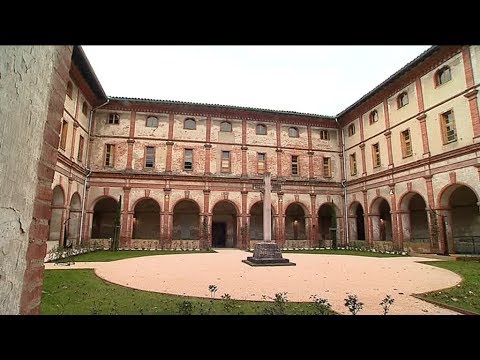 France 3 Occitanie focuses on the former Carmelite convent, a large complex in the heart of Pamiers. Its description recounts the sisters’ departure in 2008 and the building’s long religious history. As a 2018 report, it predates the Carmel’s current contemporary-art programme; viewers can use it to understand the site’s monastic past and check the municipality’s current schedule for exhibitions and access.