A town shaped by water, work and woodland
Olofström sits inland in Blekinge, where a walkable centre is only a short way from the forest-and-lake country around Halen. The town's water is not just scenery: three streams meet in the centre, and their channels helped make this a place of industry. For a precise population figure, geography matters. Statistics Sweden's 2023 register-based count lists 7,628 residents in the statistically delimited locality of Olofström (tätort, code 1060TC104). That is the built-up settlement, not the whole municipality; the municipality's own year-end total was 13,061 in 2023 and 13,000 in 2024. SCB defines a tätort as a densely built-up area with at least 200 registered residents.
From Holje to a mill community
The municipal heritage inventory, prepared with Blekinge Museum, traces the town's earlier setting to Holje village. It dates Petrefors bruk to 1735, but identifies the founding of Svenska Stålpressningsaktiebolaget in 1887 as the start of Olofström's decisive industrial period. The rivers and changes in level supplied power; over time the works became the strongest force shaping the settlement's layout and social life. The inventory records a long collaboration with Volvo beginning in the 1920s, substantial labour migration in the 1960s, when more than twenty nationalities were represented, and almost 5,000 employees at the works during the 1970s boom. Those are documented industrial milestones, not a claim that the town began with one legendary founder. Manufacturing remains part of the local identity, while the surrounding municipality also has a wooded, agricultural and lake-rich landscape.
Follow the water through the centre
At the meeting of Holjeån, Snöflebodaån and Vilshultsån, the municipal PrÅmenaden offers an easy waterside walk past benches and Badhusparken. Nearby Holje Park adds another layer: the park was laid out between 1811 and 1840, and surviving buildings now include an industrial museum, an art hall and the relocated Nebbebodagården. The latter connects the district to Harry Martinson's childhood landscape. Within the wider municipality, visitor information also points to the author's school environment at Alltidhult, the village of Jämshög and sites associated with diabase quarrying. These are outings beyond the central streets, so check access and opening arrangements before setting out.
Halen, trails and practical connections
Halen nature reserve lies about a kilometre west of Olofström and is protected as both a reserve and a Natura 2000 site. The County Administrative Board lists the Blekingeleden and Skåneleden long-distance trails through it, while Banvallsleden follows part of its eastern edge. A separate signed regional itinerary, Halen runt, is a 22-kilometre moderate cycle over mixed asphalt and gravel, passing Jämshög, Boafall, Alltidhult, Halabron, Fritzatorpet and Halens Camping. At Alltidhult, the route page notes a possible short walk toward Raslången. In town, Visit Olofström's Medborgarcenter at Östra Storgatan 5 provides maps, local advice and event information. The municipality describes connections by train to Bromölla followed by bus 561, or train to Karlshamn and buses 630/635; check current regional timetables, trail conditions and seasonal opening hours before travelling.
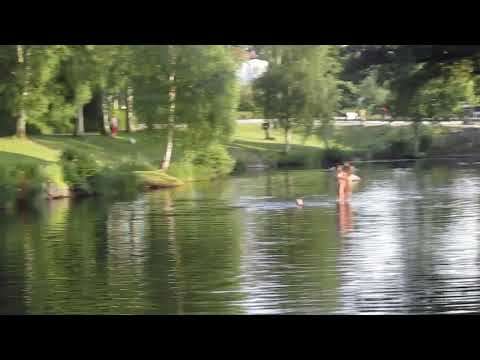 Olofström and Halen through three travel videos
 Food Outdoors' 5:16 film “Canoeing Raslången & Halen,” published 2 December 2018, takes a water-based angle on the connected lake country near Olofström. The named places make this a useful companion to a town-centred introduction: the subject is a canoe outing across the Halen–Raslången landscape, rather than a general municipal guide. Water levels, rental arrangements, and launch access can change, so check with local operators and the protected-area authority before planning a paddle.
 The third selection is a 9:54 upload from Bosanci u Švedskoj, published 24 March 2024. Its long title names Olofström, Halen's campsite and cottages, bathing, the canoe centre, and Lake Halen, setting out a practical visitor-services frame distinct from the stream-focused short and the canoe-trip film. The title does not establish what is open today; confirm camping, bathing and canoe-centre services directly, especially outside the main season.