A town built to be entered carefully
Montagnana is often introduced through its walls, but the fortification is more than a photogenic frame around a medieval centre. It explains the town’s position between Padua and Verona, the way its streets converge on gates, and why its principal landmarks were built as parts of a defensive system. The municipality had 9,193 residents on 31 December 2025, according to Istat’s provisional population balance; that figure covers the entire commune, not only the walled centre.
Older traces, without an invented foundation story
The Civic Museum’s archaeological collection places human activity in the Montagnanese territory well before the medieval town took shape. Finds from the wider area reach back to the late Neolithic and Eneolithic, while the museum describes a substantial settlement at Borgo San Zeno from the end of the Bronze Age into the early Iron Age, roughly the 12th to 8th centuries BCE. Evidence includes ceramic production, weaving, bronze work and objects made from bone, horn and glass paste. Roman-period villas and burial grounds point to dispersed rural occupation. These discoveries document a long-inhabited landscape; they do not establish that the present walled town was founded by Rome or that settlement continued uninterrupted at one site.
The municipality’s historical pages differ slightly on the year of Ezzelino III da Romano’s destructive seizure, placing it in 1238 or 1239. They associate the rebuilding of Castel San Zeno and its tall keep with about 1242. The careful account is a late-1230s conquest followed by renewed fortification, rather than a precise founding date. In the fourteenth century the Carraresi, lords of Padua, expanded and strengthened the defences. The municipality dates the main wall campaign to 1337–1362 and describes a perimeter of almost two kilometres with 24 towers, four principal gates and an outer ditch, or vallo, fed through a canal.
Read the walls as a working landscape
Begin at Castel San Zeno, the oldest surviving fortified complex, and follow the public streets around the perimeter. The wall walk and green vallo make the scale of the enclosure legible: towers were not isolated monuments but a chain of observation and defence, while gates controlled movement into the town. The eastern complex contains the mastio associated with Ezzelino, about 40 metres high. The western Rocca degli Alberi, built in 1360–1362, completes the defensive line. The municipality currently lists the Rocca as closed to visitors during renovation for a future museum, so admire it from outside and check before planning access.
Within the walls, Piazza Vittorio Emanuele II is the civic hinge between the military story and everyday town life. The Duomo of Santa Maria Assunta began in 1431 on the foundations of an earlier tenth-century church and was completed in 1502. Its late-Gothic exterior and Renaissance interior reflect that long building period. The municipal guide identifies Paolo Veronese’s signed altarpiece of the Transfiguration, a portal traditionally attributed to Jacopo Sansovino, and frescoes attributed to Giorgione. The attributions are part of the documented description, not a reason to treat every work as securely by those artists. Visitors should avoid entering during religious ceremonies.
A museum that widens the story
The Civic Museum Antonio Giacomelli occupies Castel San Zeno and is best approached as a compact history of the surrounding territory, rather than as a display devoted only to the walls. Its archaeological section moves from prehistoric and protohistoric objects to Roman rural life. Medieval and modern rooms include local paintings, ceramics and a large 16th-century map that records land, watercourses and property boundaries. The music section preserves documents and stage material connected with Montagnana-born tenors Giovanni Martinelli and Aureliano Pertile. Guided access also includes the castle courtyard and, when available, the keep’s panoramic level. Opening arrangements and guided visits can change; confirm them with the municipality or visitor office.
Food, work and a living calendar
Montagnana is also associated with Prosciutto Veneto Berico-Euganeo DOP. The protected name belongs to a production area spanning 15 municipalities in the Veneto, rather than to Montagnana alone; the town hosts the consortium and a food festival that links tasting, local producers and visitor activity. The May 2026 festival has already passed, so future dates should be checked rather than assumed. In September the Palio dei 10 Comuni brings horse racing, historical pageantry and participating communities to the walled setting. It is a modern historical re-enactment and civic event; its medieval imagery should not be mistaken for an unchanged medieval competition. Consult the current programme before travelling.
The local economy is broader than its food reputation. Padua’s 2024 municipal business profile counted 1,141 active enterprises: 383 in services, 252 in trade, 220 in agriculture, 168 in industry and 118 in construction. These are enterprise counts for that year, not a current employment census. They help explain how visitor services sit alongside farming, commerce and manufacturing in the plain.
Getting there and making time
The municipality places Montagnana about 45 kilometres from Padua and 60 from Mantua along the SR10 Padana Inferiore. The rail station lies on the Monselice–Mantua line; the current RFI timetable includes direct regional services to Padua and Mantua on selected weekdays, with different holiday patterns. The municipal transport guide locates the bus station about 200 metres from Porta Vicenza and identifies intermediate stops near Porta Padova/Castel San Zeno, Porta Legnago/Rocca degli Alberi and Porta XX Settembre. Check the operator’s live schedule for the day and direction. RFI currently notes that Montagnana station has no assistance service for passengers with reduced mobility, so plan access accordingly.
A thoughtful visit can combine the perimeter walk, the museum and Duomo, then leave time for a meal featuring the protected ham. The IAT office at Castel San Zeno can advise on museums, mobility, food and current events. Do not assume every tower, interior or festival site is open on the day: seasonal hours and restoration work matter here.
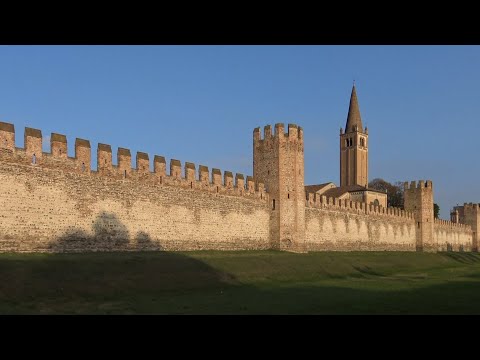 Montagnana in video: mura, Palio e Prosciutto Veneto DOP
 TvPaeseMio’s 5-minute-31-second report records the Palio dei 10 Comuni on 8 September 2012. The uploader’s description focuses on the participating communities and the event’s pageantry; it offers a dated record of one edition, not a current programme or proof that the race has continued unchanged since medieval times. Viewers planning a visit should use the Palio organisers’ latest calendar for dates and access.
 This 35-minute-38-second recording was published by the Veneto Regional Council in April 2024 to present the Festa del Prosciutto Veneto DOP in Montagnana. Its description names municipal representatives, the protected-product consortium and the event organiser, so the video is best understood as an institutional presentation of the food festival rather than a documentary about every stage of production. The 2024 dates have passed; use it for context and check the current festival programme separately.