Lescar counted 9,455 residents in 2023. Six kilometres west of Pau, it is both a living suburb in the Béarn capital’s orbit and a historic town whose upper streets open to views across the plain. The contrast is part of its character: commercial areas and agricultural activity occupy the wider municipality, while the old core gathers around a cathedral, a small museum and remnants of its medieval defenses.
Two urban layers, not one founding legend
The name Beneharnum belongs to a Roman-era settlement that municipal history places in the plain from the first century CE, between today’s Maubec and Hiaà streets and the foot of the slope. It was the principal centre of the Venarni. The hilltop town visitors see today belongs to a later chapter: tourism and heritage sources describe a medieval settlement growing around the cathedral, with walls reinforced in the twelfth century. Keeping those layers distinct matters; Lescar’s story is long, but the present town should not simply be labelled a Roman foundation.
At the top, Notre-Dame de l’Assomption gives the visit its focus. Built from the late eleventh century into the first half of the twelfth, the Romanesque cathedral is known for sculpted capitals, a mosaic often called the “Little Moorish Hunter,” a treasury of medieval objects and the tombs of Navarre’s last kings. The neighbouring museum presents finds from archaeological work in Lescar and its surroundings, while the former walls, prison tower and cathedral precinct make a compact route through the medieval city.
More than a monument stop
Lescar’s economy helps explain why the place feels different from a preserved hilltop village. The municipality describes a large retail and business area on Pau’s western edge, alongside agriculture, food-related activity and small local services. The historic centre remains the counterpoint: lanes, gardens, the square and the cathedral reward a slow visit, while shops and visitor services are spread across the wider town. A marked Tour de Beneharnum extends for 14.6 kilometres; a shorter 7.7-kilometre city-and-nature circuit links the old centre to the Carolins lake. Check the current route information and opening times before setting out.
Getting there from Pau
Idelis city buses and a regional coach between Pau and Orthez serve Lescar, according to the municipality. Pau’s railway station is about twenty minutes from the historic centre by the city’s estimate, and the A64/A65 junction connects the area by road. For visitors without a car, check current bus stops and timetables before choosing a route. Lescar works especially well as a half-day from Pau, or as a slower stop on the Béarn section of the Santiago route toward Jurançon and Oloron-Sainte-Marie.
 Lescar in three films: civic life, medieval streets and cathedral restoration
 Pau Pyrénées Tourisme leads a compact guided walk through Lescar’s medieval city and highlights the cathedral mosaic. The short format is useful for seeing how the lanes, walls and church relate to one another, while the guide’s historical framing gives the visitor a reason to pause at each site. It is a visual invitation, not a substitute for current tour dates.
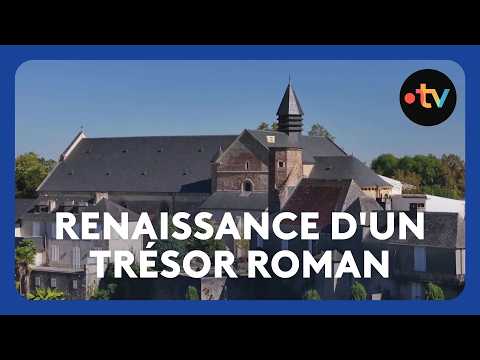 France 3 reports on the new roof for Notre-Dame de l’Assomption after a major restoration campaign. The story makes the cathedral’s upkeep visible and explains why conservation matters to the town’s landmark, beyond its well-known medieval interior. Visitors interested in architecture will find it a helpful context piece; current access and any work restrictions should still be checked locally.