A planned square in a landscape shaped by water
Gualtieri sits in the low Po plain of Reggio Emilia, where the river is both a line on the map and a force that has repeatedly altered settlement and work. The town’s most arresting feature is not a single tower or church but the broad, porticoed Piazza Bentivoglio: a square designed to make the political centre of a small fief feel like a stage. The municipality describes it as a square about 94.4 metres on each side, with arcades around three sides and the civic tower, the parish church and the Bentivoglio residence completing the composition. Its scale is striking in a settlement of this size, and it gives a visitor a clear starting point for understanding how architecture, power and land reclamation were bound together here.
The Provincial population table records 6,308 residents for the entire municipality on 1 January 2024. That is a municipal total, not a count of the historic centre alone. The town includes the communities of Santa Vittoria and Pieve Saliceto, each with its own history and everyday services. Gualtieri rewards a slow visit: first the formal geometry of the main square, then the older streets and parish buildings, and finally the open country and river embankment that explain why this planned town was never simply a courtly backdrop.
What archaeology says—and what remains uncertain
The municipality’s account does not claim a Roman foundation. It notes Bronze Age material associated with the nearby Terramare settlement of Santa Rosa at Poviglio, followed by more substantial Iron Age and Etruscan finds. Those discoveries challenge an older assumption that Roman objects found around Palazzina and Castellazzo marked the beginning of a permanent town. The name appears in written form much later. Its possible derivation from “Castrum Vulturena” and “Castrum Walterii”, and a story that links the latter to a Lombard named Gualtiero in the seventh century, are presented by the local history as possibilities rather than a proven origin.
The municipal narrative places the earliest medieval urban nucleus around the church of Sant’Andrea and the long, triangular Piazza Felice Cavallotti, whose street pattern took shape between the eleventh and thirteenth centuries. Political control changed repeatedly. The Este family secured Gualtieri in 1479; in 1567 Alfonso d’Este granted the fief of Castelgualterri to Cornelio Bentivoglio, and in 1576 it became a marquisate. These documented changes help explain why Gualtieri acquired an unusually ambitious civic plan without turning its history into a legend of ancient origins.
Piazza Bentivoglio and the rooms of the palace
The square works as both public space and former court of honour for Palazzo Bentivoglio. The municipal description credits the ducal architect and hydraulic engineer Gian Battista Aleotti, known as l’Argenta, with a documented role in the design while acknowledging that the project may have had more than one author. The palace grew out of an older castle complex. Ippolito Bentivoglio developed the residence around the turn of the seventeenth century; much of it was demolished after the municipality acquired the building in 1751, and its bricks were reused to strengthen the Po embankments. Two corner towers survive from the original four.
Where the square is spare and rhythmic, the palace rooms are narrative. The Salone dei Giganti carries scenes drawn from Torquato Tasso’s Gerusalemme liberata; other rooms present episodes from the story of Aeneas, Roman foundation legends, Jupiter and Icarus. The distinction matters: the mythological paintings are subjects of the decoration, not historical evidence that Gualtieri was founded by the heroes they depict. Santa Maria della Neve, integrated into the southern side of the square, and the older Sant’Andrea in Piazza Felice Cavallotti offer two different chapters of religious and civic life.
Ligabue, Tirelli and a theatre that changed its rules
Gualtieri’s cultural life is closely connected with people who left and returned in memory. Antonio Ligabue was born in Zurich in 1899; sent to Gualtieri in 1919, he spent much of his life in the Po floodplain and died here in 1965. The municipal documentary museum preserves photographs, archival material and works connected with his art. It sits alongside the Tirelli–Trappetti collection: Umberto Tirelli, born in Gualtieri in 1928, became a celebrated theatre and film costume maker, and the collection in Palazzo Bentivoglio includes works donated by him and Dino Trappetti. A municipal notice describes the renewed palace exhibition rooms opened in 2025; opening days, prices and access arrangements should be checked before travelling.
The Teatro Sociale occupies the palace’s north wing. A wooden theatre was created in 1775, burned, and was later replaced by a theatre with iron-cast tiers. After a period of decline and the removal of its original stage during roof work in the 1980s, a local group and the municipality brought it back into use from 2009. Its current “reversed theatre” arrangement turns the usual relationship between stage and audience around, creating a flexible room for experimental performance and concerts. It is an active cultural venue, so the programme is more useful than assuming daily access.
Villages, farms and the memory of the floods
The wider municipality is not just its central piazza. Santa Vittoria, once known as Gambararia, developed through drainage works, a large agricultural estate and cooperative traditions. The municipality records the founding of a workers’ mutual-aid and loan society in 1879 and describes Santa Vittoria’s cooperative agriculture as an unusually advanced local experience. Pieve Saliceto grew around an old parish church; recurrent Po floods led residents to move the settlement beyond the main embankment. Today the official town pages list everyday services in the hamlets as well as farms, bars, food shops and pharmacies. That living network gives the territory a social scale that a quick photograph of the central square misses.
Flood memory is visible in the architecture. The municipal history records major inundations in 1765 and 1951; during the November 1951 flood, water reached the springing of Piazza Bentivoglio’s arches, about 3.8 metres above the square. The river edge and the embankment are therefore not decorative scenery. They are part of the town’s engineering history, its agricultural economy and the reason visitors should respect current river conditions and access notices.
Planning a visit
Begin at Piazza Bentivoglio, then continue along Via Vittorio Emanuele II to Piazza Felice Cavallotti and Sant’Andrea. If the palace is open, allow time for the frescoed rooms, the Ligabue material and the Tirelli–Trappetti collection rather than treating it as a brief stop. The municipality has installed interpretive panels at 15 artistic, architectural and natural points in the town and its hamlets; their QR codes lead to an Italian- and English-language audio guide. The square has bars, restaurants, shops, a post office and banking services nearby, while the town centre is compact enough to explore on foot. Check the theatre and museum calendar separately because these are event- and schedule-dependent visits.
Gualtieri has a railway station on the Parma–Guastalla–Suzzara line. From Parma, regional trains run along that corridor; from Reggio Emilia, the rail route to Guastalla can be connected with the Parma–Suzzara service. The current operators’ pages also publish replacement-bus notices, so check the journey for the exact date rather than relying on an old timetable. By road, the municipality’s access information points to the A1/Reggio Emilia approach and the SS63 towards Guastalla and Mantua; from Parma, the SS62 route passes through Brescello and Boretto. Guastalla is a nearby companion for a wider Po-plain itinerary, while Brescello and Boretto add river, local-history and water-management stops. Gualtieri’s strength is the contrast between a carefully staged Renaissance centre and a working river landscape that has never been entirely under human control.
LINKS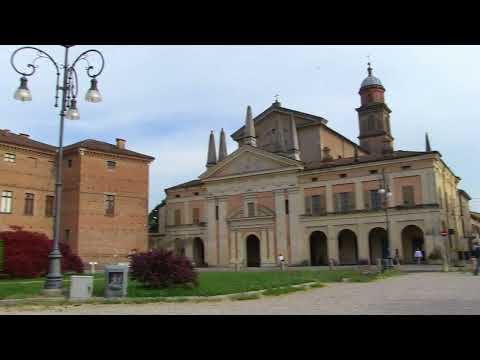 Gualtieri in three films: the borgo, its territory and Palazzo Bentivoglio
 The municipality’s “Presentazione del territorio di Gualtieri” widens the frame from the central borgo to the surrounding municipal area. It is a useful companion when planning to include Santa Vittoria, Pieve Saliceto or the Po landscape in the same visit.
 “Gualtieri (RE) - Palazzo Bentivoglio SUB ENG” is a Ducato Estense feature dedicated to the palace, with English subtitles. It gives international viewers a focused cultural introduction to the building; the municipality remains the source for current access and opening details.