A river village between fields and wooded slopes
Gagnef is not just a name for a municipality: the small built-up locality sits in the older church-village landscape known as Gagnefs kyrkby. The river, open cultivated land and forested ridges give it a quieter scale than Dalarna’s larger centres. Statistics Sweden counted 1,257 residents in the statistical locality of Gagnef (tätort code 2026TC106) in 2023. That figure refers to the connected built-up area, not everyone living in Gagnef municipality or its other villages. The surrounding settlement pattern matters here: old villages ran along the river, with farms set among fields and wooded heights.
Work, movement and a changing cultural landscape
Visit Dalarna’s account of the church-village culture walk records how local livelihoods once combined farming with secondary work such as handicrafts and seasonal journeys to Stockholm and the Mälaren region. The river served as a transport corridor until the railway began to compete with it in the 1880s. These are documented strands of a wider rural economy, not a claim that every household or later period was the same. In the present day, the municipality describes a broader business base of small and medium-sized firms alongside export-oriented, high-technology production. That municipal picture should not be mistaken for an industry count for the 1,257-person locality itself. The landscape, old village settings and cultural tourism remain visible parts of Gagnef’s public identity.
Ottilia Adelborg’s adopted home
The strongest cultural thread is Ottilia Adelborg, the children’s-book illustrator, artist and writer who lived and worked in Gagnef from 1903 until her death in 1936. In Gagnefs kyrkby, the museum named for her occupies the former rectory, an eighteenth-century building. Its collections bring together illustration, literature, art, folk costumes, lace and objects from Gagnef. Nearby, the church is a landmark with several historical layers: a wooden church stood by the river in the thirteenth or fourteenth century, a stone church followed in the fifteenth, and construction of the present church began in 1766. Its medieval altarpiece and a 1929 painting by Adelborg of Saint George and the dragon make the connection between place, worship and local art especially tangible. The cultural walk uses old photographs and Adelborg’s own words; it is a way into the village’s social history, not a reconstruction of every detail.
Walk, cycle and plan around local schedules
Kulturstråket has ten optional stops and covers nearly two kilometres through Gagnefs kyrkby. For a longer day, Visit Dalarna describes a roughly 40-kilometre cycling circuit from Sifferbo, about 11 kilometres outside Gagnef toward Borlänge. The easy, relatively flat route takes an estimated three to five hours and links Djurmo, Djurås, Gagnefs by, the church village and Österfors, including two of the area’s distinctive floating bridges. It is not signposted, so use the current route map and check surfaces and bridge access before departure. The meeting of Österdalälven and Västerdalälven is at nearby Djurås, not in Gagnef’s statistical locality. The museum is at Kyrkbyvägen 36; exhibitions and opening times change, and group visits should be arranged ahead. Check transport connections, museum hours and route conditions before travelling.
 Three Gagnef heritage films: church walk, floating bridge and memorial cottage
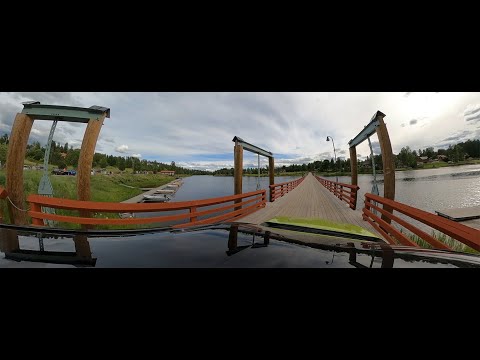 Sweden 360 published ‘Gagnef Flottbro 360’ on 9 July 2020; the verified upload runs 5:30. The named subject is one of Gagnef’s characteristic floating bridges, a practical river crossing and a distinctive part of the village landscape. This gives the set a built-heritage perspective separate from the church and museum themes. Check the current route map and bridge access before setting out; the cycle circuit is not signposted.
 Riksantikvarieämbetet, Sweden’s national heritage authority, published this 2:38 video on 26 April 2019 with the title ‘Minnesstugan i Gagnef – ett verk av Ottilia Adelborg’ (‘The memorial cottage in Gagnef—a work by Ottilia Adelborg’). The subject directly complements the museum’s account of Adelborg’s life and regional work. The verified title and publisher establish its heritage focus, but not visitor access; check local information before planning a visit.