Castiglione di Garfagnana is best understood from its walls. The Tuscan village stands above the Serchio valley, where the road north climbs toward the Apennine passes and Emilia. Five towers and a compact stone centre make that frontier role visible, but the place is more than a picturesque fortress: churches, civic rituals, working countryside and mountain settlements belong to the same municipal territory. ISTAT’s estimated resident population for 1 January 2026 is 1,685 for the whole municipality, including its outlying settlements, not just the walled village.
A medieval record, and an older origin story
Local and regional tourism accounts trace Castiglione to a Roman castrum, later enlarged under the Lombards and Franks. That is a tradition worth recording, but it should not be confused with the firmer documentary record: the Italian state’s archival inventory says the first reliable notices of the town date from the twelfth century, when it was already fortified. The surviving character of Castiglione is therefore most securely read through its medieval history. Control of this mountain corridor made the settlement valuable to Lucca and contested by neighboring powers.
The town endured repeated attacks. The municipality’s historical account describes a siege and damage in 1170, later struggles for control, and the reconstruction of its substantial walls and fortress in 1371, when Lucca secured the settlement. Castiglione remained a Lucchese stronghold within a Garfagnana increasingly associated with the Este rulers of Modena. In 1613, a major Este siege nearly forced the town to surrender; the municipal history says peace imposed by the Spanish viceroy prevented its fall. These events explain the unusually forceful defensive outline that still encloses homes and streets.
Following the towers and the churches
Enter through one of the historic gates and walk the perimeter before turning into the lanes. The circuit brings the towers of Brunella, the Clock, Fattori, San Michele and San Pietro into view; from the Torrione della Brunella and the Parco della Rimembranza, the outlook opens over the valley and surrounding ridges. The nearby Rocca rises above the roofs, but it is privately owned. The local Pro Loco arranges guided visits by appointment, sometimes including the fortress, so visitors should contact the association before planning to go inside. In summer, parts of the tower and former prison spaces may be open under local arrangements; access is not guaranteed year-round.
San Michele repays a slower visit. The church is documented from the twelfth century and retains a distinctive façade combining grey stone and red marble. Inside, a Madonna and Child painted by Giuliano di Simone of Lucca is dated 1389. A wooden crucifix is traditionally said to have come from the vanished settlement of Verrucchia; that provenance is local tradition, not a proven biography of the object. San Pietro is the other principal church within the walls. Together, the two buildings show how worship and civic life developed alongside the fortifications rather than outside them.
Rituals that still belong to the town
Castiglione’s best-known annual customs are not simply medieval pageants. The Festa del Regalo follows a civic decision dated 20 January 1631, made after the community believed it had been spared the plague then spreading through Europe. Each year, the mayor and residents accompany a young child from the town hall to San Michele with a symbolic gift of gold, incense and myrrh. The municipality describes the ceremony as both civic and religious. The Festa Medievale, organized by local associations, fills the walled streets with historical processions, crafts and performances. Its reenactments are contemporary community events, not evidence that every scene reproduces a specific documented episode. Dates and programmes change, so check the current municipal calendar.
For a wider view of local life, continue uphill to San Pellegrino in Alpe, a mountain settlement in the same municipality. Its Don Luigi Pellegrini Ethnographic Museum occupies rooms in a medieval hospice and presents tools, household furnishings and crafts from the rural communities of the Tuscan-Emilian Apennines. The collection includes domestic interiors, farming, textile and dairy work, blacksmithing and carpentry. It gives context to a landscape shaped by seasonal labor and travel across the pass, rather than treating the mountains as scenery alone. Check the museum’s current opening days before setting out.
Getting there and making a day of it
Castiglione is reached by road along the Garfagnana corridor. For public transport, take a regional train on the Lucca–Aulla line to Castelnuovo di Garfagnana, then check Autolinee Toscane’s E56 service toward Castiglione and Passo delle Radici. The bus operator lists the route and active diversions; departures vary by day and season, and the final stop may not be at the historic centre. Verify the current timetable and connection before travelling. Castelnuovo is also a practical base for other services and nearby destinations in the valley.
A rewarding visit pairs a walk around the walls with time inside San Michele, a pre-booked guided visit to the Rocca, or the longer mountain excursion to San Pellegrino and its museum. The village’s interest lies in that combination: a defensible medieval centre still inhabited, a documented civic memory, and roads that continue from its gates toward the Apennines.
 Castiglione di Garfagnana on video: fortified streets, a medieval festival and a living civic ritual
 This short teaser comes from the local Pro Loco and promotes Castiglione’s Festa Medievale. The association describes a two-day programme that uses the walled streets for historical processions, craft stalls, performances and traditional food. The film is therefore useful as a preview of the event’s community and visitor atmosphere, not as evidence about medieval life or a record of a particular historical episode. Festival dates and activities change from year to year; pair the video with the municipality’s current event notice before making travel plans.
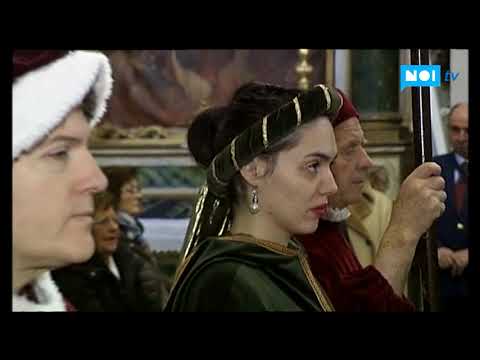 NoiTv Lucca’s report focuses on the Festa del Regalo, a civic and religious ceremony that the municipality traces to a local resolution of 20 January 1631. The annual procession from the town hall to San Michele and the symbolic gift carried by a child make a long-standing communal observance visible in a way a written description cannot. The video is journalistic coverage of one celebration, not a guarantee that every detail remains identical each year. The municipality’s current account is the better source for the origin story and present-day programme.