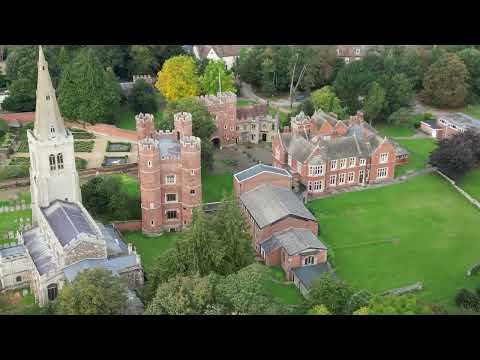
Buckden lies close to the A1 in Cambridgeshire, between the larger centres of Huntingdon and St Neots. Its old High Street preserves the character of a stopping place on the Great North Road, while the brick tower and gateways of a medieval bishops’ palace rise beside the parish church. The village is particularly associated with Catherine of Aragon, but its history also embraces episcopal administration, coaching traffic and later religious use. Historic buildings remain part of daily life, including places to stay and eat within the village.
| Residents | 2,881 |
|---|---|
| Area counted | Buckden (Huntingdonshire) civil parish — civil parish census area |
A palace village rather than a military castle town
Buckden developed around an estate belonging to the Bishops of Lincoln and is recorded in Domesday Book. Its position between Lincoln and London made it useful to bishops travelling between their responsibilities. The palace combined residence, administration and hospitality; its impressive tower should not be mistaken for evidence that the whole village began as a Norman military fortress.
The district conservation statement traces the changing palace and its relationship with the road. Much of the surviving brick work belongs to the great late-fifteenth-century rebuilding under Bishops Thomas Rotherham and John Russell. Buildings lost in later centuries once formed a much larger complex than the remains visible today.
The Great Tower and gatehouses
The Great Tower is the most striking survivor of Buckden Palace. Brick construction, battlements and the gateways convey the status of a powerful household as well as a concern for enclosure. Historic England also identifies the inner gatehouse, outer gate and sections of wall among the surviving medieval elements.
The arrangement is easier to understand by looking at the different parts together, including the church and later house. Do not expect a complete palace interior behind every surviving wall. The village’s conservation guide provides useful context for what was rebuilt or demolished, while the continuing use of the grounds gives the site a different atmosphere from an entirely unoccupied ruin.
Catherine of Aragon’s stay
After the annulment of her marriage to Henry VIII, Catherine of Aragon stayed at Buckden from July 1533 until May 1534. She was then moved to Kimbolton, where she died in January 1536. Her burial is at Peterborough Cathedral. Buckden, Kimbolton and Peterborough therefore represent different stages of the same story and can form a coherent historical itinerary.
The surviving palace buildings give a setting for that episode, but later alterations changed the complex substantially. The association does not mean that a visitor is entering a complete preserved royal apartment. It is the combination of the documented stay, the surviving medieval fabric and the wider Tudor landscape that makes the place significant.
Buckden Towers today
The Claretian Missionaries have owned Buckden Towers since 1956. The site now combines religious life, heritage, conference activity and residential stays. The operators normally keep the gates open for visitors to the grounds, with restrictions possible when particular events require them.
The Claret Centre welcomes day and residential groups, and the operators also describe self-contained apartments available to individuals and families. This is a different arrangement from turning up at a conventional hotel reception. Contact the centre about the type of stay or visit intended, and respect areas in active private use. An organised tour can add more than an unplanned look through an open gateway.
High Street, church and village hospitality
The old road explains the number and prominence of historic inn buildings. Walking High Street reveals houses and former stopping places that once served travellers before modern traffic moved to the A1. St Mary’s church gives another focus beside the palace. The short distances allow a visit to concentrate on buildings and street relationships rather than repeated drives between attractions.
The Lion operates as a coaching inn with rooms, a restaurant and bar in Buckden. It provides an option for staying within the village and exploring on foot. Confirm food service, room access and parking directly when booking. For someone considering a move, an ordinary evening here and a daytime walk to local facilities help reveal how the old centre functions beyond its Tudor connections.
Huntingdon, St Neots and the wider region
Whippet’s current route 66 connects Buckden with Huntingdon and St Neots, along with other places on the corridor. Both larger towns provide main-line railway gateways; Buckden itself has no operating passenger station. Choose the bus stop, service and return time around the full journey rather than assuming that proximity to the railway makes the final stage automatic.
Road access via the A1 is useful for journeys north and south, while the wider A14 corridor connects towards Cambridge. At the 2021 census, Buckden civil parish in Huntingdonshire had 2,881 usual residents. This identifies the Cambridgeshire village and its parish, not Buckden in the Yorkshire Dales. The figure also includes land beyond the old High Street and palace surroundings.
Sources
- District council: village development and palace building phases
- Historic England: the Great Tower
- Historic England: surviving medieval palace buildings
- Buckden Towers operators: visits, Claretian ownership and accommodation
- Buckden Local History Society: palace and Catherine of Aragon
- Peterborough Cathedral: Katharine’s death at Kimbolton and burial
- The Lion: village hotel, restaurant and coaching-inn setting
- Whippet: current route 66 connections
- Office for National Statistics via Nomis: Census 2021 usual residents, civil parishes