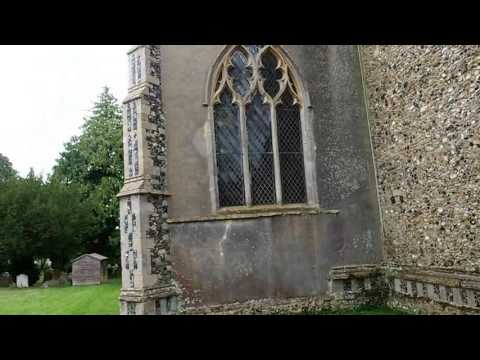
Bildeston occupies a sheltered part of Suffolk’s Brett valley, with timber-framed houses, a market place and an unusually separate parish church on the ridge to the west. The gap between church and village is a clue to its history: the settlement shifted towards a more convenient commercial site during the Middle Ages. Today the lanes, historic houses and a long-established inn make an appealing base for exploring inland Suffolk, while a school, health services and village organisations sustain a community beyond the visitor trade.
| Residents | 1,093 |
|---|---|
| Area counted | Bildeston civil parish — civil parish census area |
Before the market place
Prehistoric flints and evidence of Roman activity have been found in the surrounding landscape. Those finds show people using the valley at different periods; they do not establish that the present village was founded as a Roman town. Bildeston is recorded in Domesday Book in 1086, when the settlement was associated with the hilltop site beside a predecessor of the surviving church.
The village name reflects the mixture of English and Scandinavian influences found elsewhere in East Anglia. Its securely documented medieval development is more revealing for a visit than a precise foundation date inferred from the name. The church, old settlement area and later valley streets represent successive stages rather than one village laid out all at once.
Why the church was left on the hill
A market charter acquired in 1264 by Matthew de Loveyne helped favour a new site nearer passing trade. Over time, residents moved towards the valley, while church and manor remained above it. By the end of the fifteenth century the older settlement had largely disappeared. The familiar tale that plague alone emptied and destroyed the original village oversimplifies a longer economic change.
Earthworks once made the abandoned settlement easier to read, but ploughing in 1974 removed much of the visible pattern. Finds recovered afterwards included substantial medieval pottery. Follow the public approach to the church rather than expecting a reconstructed deserted village or permission to explore surrounding fields. The separation itself, and the view back towards the present settlement, make the story tangible.
St Mary Magdalene and the historic streets
St Mary Magdalene is principally a late medieval church, with a particularly elaborate porch. Its present west tower reflects rebuilding after the earlier tower collapsed in 1975. The contrast between old fabric and later intervention is part of the building’s history, rather than a reason to overlook it.
Back in the village, Chapel Street and High Street preserve timber-framed houses behind a variety of later façades. The conservation appraisal identifies several especially important groups, including jettied buildings in Chapel Street. Look above ground-floor windows for changes in construction and frontage. Many of these houses are private homes: their contribution to the streetscape can be appreciated without entering gardens or treating every old doorway as a public attraction.
Markets, work and a continuing community
Markets and fairs once connected Bildeston with the surrounding farms and wider Suffolk trade. Textile work, malting and brewing formed other strands of its economy, followed by changing patterns of retail and rural employment. The market place remains a useful point from which to understand the village’s commercial layout even though its medieval market arrangements no longer operate unchanged.
The village website lists a primary school, health centre, grocery and post office, community hall and recreation facilities. These are practical parts of a stay as well as indications of how the place works for residents. For a prospective move, compare an address in the compact centre with one on an approach road: the walking route to services can matter as much as the apparent distance on a map.
The Crown: rooms and a meal in the village
The Bildeston Crown began as a late medieval merchant’s house and had become an inn by the seventeenth century. It now offers thirteen en-suite rooms on High Street, together with bars, dining spaces and outdoor seating. Staying here puts the historic centre within reach on foot, while the church walk provides a distinct outing above the streets.
The kitchen works with produce from Nedging Hall Estate and other local suppliers, so the menu changes through the seasons. Choose the service and current menu directly with the business; a set lunch, evening meal and a special dining event are separate offers. The inn provides an example of an operating village stay, without requiring a night in a larger town.
Connections through Stowmarket and Ipswich
Suffolk’s current transport information lists route 51 between Hadleigh, Bildeston, Great Finborough and Stowmarket. Stowmarket provides a railway connection on the Great Eastern main line, useful for journeys towards Ipswich, Norwich and London. Confirm the current local bus timetable and the return connection before arranging a visit around it. Bildeston has no railway station of its own.
The official 2021 census recorded 1,093 usual residents in Bildeston civil parish. The parish includes land beyond the built-up streets, so that figure should not be read as a headcount confined to the market place and its immediate lanes. A day split between village, church ridge and an ordinary journey to a larger service centre gives a fuller picture than a short stop outside the inn.
Sources
- Bildeston community history by local historian Sue Andrews
- Bildeston: evidence for the old settlement and market-site shift
- Babergh District Council: Bildeston conservation area appraisal
- The Bildeston Crown: accommodation and seasonal dining
- The Bildeston Crown: history of the building
- Suffolk County Council: current bus network updates
- Office for National Statistics via Nomis: Census 2021 usual residents, civil parishes